Video Editing Protocol
Internal workflow for classifying source media, selecting the editing stack, producing destination-specific formats, and blocking any output that has not passed synchronization, caption, image-quality, motion, and playback checks.
- Release state
- Private review first
- Sync standard
- Technical + perceptual
- Source rule
- Classify before editing
Source first
Source-to-output decision matrix
Capture origin and phone orientation are separate facts. Detect what the file proves; never guess what metadata cannot prove.
| Capture path | Orientation | Source of truth | Reels / Shorts output | Synchronization rule |
|---|---|---|---|---|
| Loom mobile app Approved Sequential Domination precedent | Landscape — phone sideways | Best single muxed Loom rendition containing paired video + audio | 1080×1920 vertical canvas; fit the complete landscape frame without crop or enlargement; thesis above and captions below | Measure clean onsets early/middle/late. This approved source required +200 ms audio and the identical +200 ms caption shift; do not inherit that number without a new canary. |
| Loom mobile app | Portrait — phone upright | Best single muxed Loom rendition containing paired video + audio | Native 1080×1920 portrait; fixed source-authentic frame; protect face, shoulders, hands, and platform safe zones | Classify aligned, constant offset, or drift. Never assume the landscape precedent’s +200 ms value. |
| iPhone Camera → uploaded to Loom | Landscape — phone sideways | Original iPhone file; Loom is transport/review unless original-byte identity is proven | 1080×1920 vertical with complete landscape frame fitted, or an explicitly approved fixed wide crop; no tracking or blur filler | Test the original iPhone file first, then compare Loom playback/download. Use the original if Loom introduces offset, drift, or compression. |
| iPhone Camera → uploaded to Loom | Portrait — phone upright | Original iPhone file; preserve native orientation and paired camera audio | Native 1080×1920 portrait; no invented landscape canvas, head-only crop, or automatic face tracking | Baseline-test original and Loom copy. Any correction is source-specific and moves captions identically. |
| Loom desktop — office | Landscape 16:9 | Single muxed Loom original | 1920×1080 landscape by default; vertical derivative only with Brad’s approved fitted-landscape or fixed wide-crop treatment | Run the same original-source onset test; frame/sample lock is required but is not perceptual sync proof. |
| Original file from Drive/local storage | Measured from the actual file | Highest-resolution camera original or first-generation export with paired audio and documented provenance | Match the requested destination without unnecessary crop, enlargement, frame-rate conversion, or intermediate re-export | Establish baseline sync on the original before any edit; identify camera-original, screen recording, or prior export. |
| Other camera or screen recording | Measured from pixels and rotation metadata | Original card/file or lossless first-generation capture | Select landscape, portrait, square, or fitted-canvas treatment from source and destination—not filename | Check variable frame rate, separate microphone clocks, screen/camera tracks, and drift before normalization. |
| Externally edited export | Measured | Original project/source media preferred; use the export only when upstream assets are unavailable | Avoid compounding crop, captions, sharpening, denoise, or compression | Treat embedded edits and timing as inherited risk; compare against the earliest accessible source. |
| YouTube/social-platform download | Measured | Last-resort recovery source only | Do not upscale or represent transcoded pixels as original quality | Document platform-transcode limitations and block release if a better source should exist. |
| Continuous “Apple” batch | Inherit parent orientation | Same parent source path and checksum; one child manifest per script | Each child inherits its parent composition, caption zone, and delivery target | Classify parent sync before splitting; preserve the same paired correction through every child; verify each boundary in motion. |
Mandatory intake manifest: capture origin, capture app, iPhone Video-or-Cinematic mode, selected HD-or-4K resolution, selected 24-or-30 frames per second, Loom-or-iPhone source of truth, measured orientation, delivered dimensions and frame rate, audio rate, duration, muxed/split status, intended destination, framing profile, sync classification, correction milliseconds, caption offset, and source checksum. Preserve selected camera settings separately from delivered-file metadata because Loom may transcode the upload. If metadata cannot prove a field, ask Brad once—do not infer it.
Approved precedent
Loom landscape → vertical Reel
The exact Sequential Domination treatment Brad approved for resolution and synchronization.
Caption continuity: Arial Bold; 58 px at 1080×1920; two lines maximum; controlled phrase grouping; white base text with high-contrast black backing/outline. Use yellow and cyan only for semantic emphasis—not random rotation. Keep the thesis in the upper safe zone. For fitted landscape, keep spoken captions below the picture; for native portrait, select a stable upper or lower safe zone that does not cover Brad’s face or gestures. No bouncing word-by-word animation.
Required social-copy CTA: Every edited social-video caption includes a natural, topic-specific lead-in followed by: “Comment AUTOMATE and I’ll send you the Automate and Delegate newsletter.” Keep the keyword uppercase and verify the destination automation before release.
Required order
The six-gate workflow
No stage is skipped because the volume is high. The system makes volume safer.
Intake
Identity + pairing proofLock the synchronized Loom source
Inventory Loom’s renditions and prefer the single muxed file containing its paired video and audio. Record URL/file, source type, dimensions, rates, duration, and SHA-256. Separate HLS tracks are diagnostic fallbacks—not the default master.
Normalize
Timing foundationMeasure before resetting clocks
Probe original timestamps and inspect visible speech before creating a 30 fps CFR / 48 kHz mezzanine. Never independently zero, stretch, or remux audio and video and then call equal starts proof of sync.
Plan
Tool-assisted judgmentTranscribe, compare tools, and select complete thoughts
Use faster-whisper locally. When authenticated and useful, compare OpusClip clip, hook, and reframe candidates plus Captions.ai caption treatments. Select from source evidence; preserve chronology and natural delivery.
Render
Coupled sync controlUse one paired A/V edit decision list
Every cut uses one shared boundary. If clean onset testing proves a constant source offset, apply one documented global correction and shift caption timing by the identical amount.
Verify
Brad confirms syncProve lips, sound, motion, pixels, and captions
Deliver a 20–30 second motion canary containing a clean speech onset. Check early, middle, CTA, and ending alignment; distinguish constant offset from drift; then run image, caption, decode, and safe-zone checks.
Release
Approval + playback gatedStop at private review and platform HD
Publishing begins only after Brad approves the exact master. Keep YouTube unlisted until the intended HD rendition exists and plays; provider “processing succeeded” alone is not release proof.
Tool selection
Editing capability matrix
Use the strongest suitable tool at each stage. No third-party convenience render becomes the synchronization or quality authority.
| Tool | Current route | Use in workflow | Control |
|---|---|---|---|
| Loom rendition audit | Source-dependent | Acquire the best muxed Loom file and compare alternatives when diagnosing | Split HLS tracks are never assumed synchronized |
| ffprobe + SHA-256 | Available locally | Dimensions, orientation, streams, clocks, duration, codec, and immutable identity | Required at intake and final master |
| FFmpeg | Available locally | Normalize, trim paired streams, correct measured offset, compose, caption, encode, and decode-check | Authoritative deterministic finishing layer |
| faster-whisper | Available locally | Word-timestamp transcription and caption timing | Text and timing require human review |
| HyperFrames | Available locally — v0.8.25 | Designed graphics, motion, reframing, and advanced media treatment when requested | Optional; never add overlays or effects that violate the approved treatment |
| OpusClip | Browser/API authorization must be re-proven | Candidate clip discovery, hook scoring, reframing comparison, and draft captions | Never the final sync, crop, caption, or export authority |
| Captions.ai / caption editor | Browser/API authorization must be re-proven | Caption-style alternatives and draft packaging when useful | Final words, timing, colors, placement, and safe zones are checked against source |
| yt-dlp | Available locally | Permitted source retrieval and platform-format inventory | Never use a social re-download when a better original exists |
| Lip-onset canary | Required human review | Clean speech resumptions early/middle/late; constant offset separated from drift | Brad’s playable-canary confirmation is the sync gate |
| Vimeo | Private review route proven | Full-quality review delivery and playback verification | Unlisted/private before release |
| YouTube / Metricool / native tools | Post-approval only | Destination upload, status, high-definition rendition, and native playback verification | Exact approved checksum and destinations only |
Universal exclusion: No AI-generated visuals, avatar replacement, unrelated B-roll, blur filler, detached voice, fake camera movement, or unapproved music.
Permanent capture reference
iPhone and Loom capture settings
Record what Brad selected before filming separately from what Loom later delivers. “Frames” means frames per second (fps), not frames per minute.
Two truths
Selected settings versus delivered file
These fields must never be collapsed. A 1080p Loom download does not prove the iPhone was set to HD; a 4K original may have been downsampled.
| Field | Capture truth | Delivered-file truth | How to prove it |
|---|---|---|---|
| Capture app | iPhone Camera or Loom mobile | May not survive export metadata | Brad confirmation, screenshot, and original-file metadata when available |
| Camera mode | Standard Video or Cinematic | Ordinary exported pixels may not prove the selected UI mode | Pre-recording screenshot plus original iPhone asset metadata |
| Selected resolution | HD or 4K | Measured width × height after Loom processing | Screenshot/original metadata versus ffprobe on the Loom rendition |
| Selected frame rate | 24 or 30 fps | Measured average and nominal frame rate | Screenshot/original metadata versus ffprobe; record variable-frame-rate behavior |
| Orientation | Portrait or landscape | Measured dimensions plus rotation metadata | Probe the actual file; do not infer from capture app |
| Synchronization | Camera/microphone behavior at capture | May change after upload or platform processing | Early/middle/late canary on both original and Loom-delivered copy |
Current evidence
Observed Brad sources
Empirical results are source-specific—not universal Loom specifications.
| Source | Known capture settings | Loom-delivered file | Synchronization result | Interpretation |
|---|---|---|---|---|
| No Tolerance for Bullying and Modeling September 3, 2026 | iPhone Camera · Standard Video · landscape · HD · 30 fps Brad-supplied Camera screenshot shows the selected Video configuration; Loom delivery corroborates 1080p/30 | 1920×1080 HD · H.264 · 30 fps · SDR/BT.709 | Zero-correction early/middle/late canary approved by Brad | Upload path retained strong 1080p delivery and perfect observed sync; original iPhone file remains the higher-authority source |
| Sequential Domination Approved historical precedent | Direct Loom mobile · landscape | 1294×720 muxed rendition · approximately 30 fps | Required a source-specific +200 ms audio and caption correction | Useful measured precedent, but not proof that every direct Loom recording uses the same quality or offset |
Current Loom documentation boundary: Atlassian’s official “Record with Loom for iOS” guide, last modified May 27, 2026, documents front/rear camera selection and camera recording but does not state a guaranteed mobile-camera capture resolution, bitrate, codec, or frame rate. Treat those values as unknown until the resulting file is measured. Open the first-party Loom guide.
Controlled comparison
Determine the best repeatable path
Use the same scene, lens, orientation, lighting, microphone, movement, and spoken test so only the capture path changes.
Fastest path
Measure resulting fileDirect Loom mobile
Record 15–20 seconds with a clap, clean consonants, head turn, hand motion, fine desk detail, and natural movement.
Controlled HD
Efficiency baselineiPhone Video · HD · 30 fps
Keep the original file, then upload the same take to Loom. Compare original and delivered resolution, bitrate, sync, texture, and transfer time.
Quality baseline
Recommended starting standardiPhone Video · 4K · 30 fps
Keep the original file, upload to Loom, and compare downsampled detail, motion, compression, transfer time, and edit headroom.
Optional look test
Not the defaultiPhone Cinematic · 4K · 30 fps
Run only after Standard Video is established. Inspect hair, hands, glasses, background edges, focus changes, stabilization, and metadata compatibility.
Acceptance decision: standardize on the lowest-friction path that passes original/delivered detail, early/middle/late lip sync, natural motion, stable focus, transfer time, edit reliability, and final-platform 1080p playback. Until the controlled comparison is complete, use iPhone Standard Video at 4K/30 fps for quality-sensitive filming and retain the iPhone original.
Screenshot evidence
Brad’s iPhone setting screens
Original Telegram image bytes preserved September 3, 2026. The selected settings are identified by yellow dots in the Camera interface.
Standard Video · HD · 30 fps
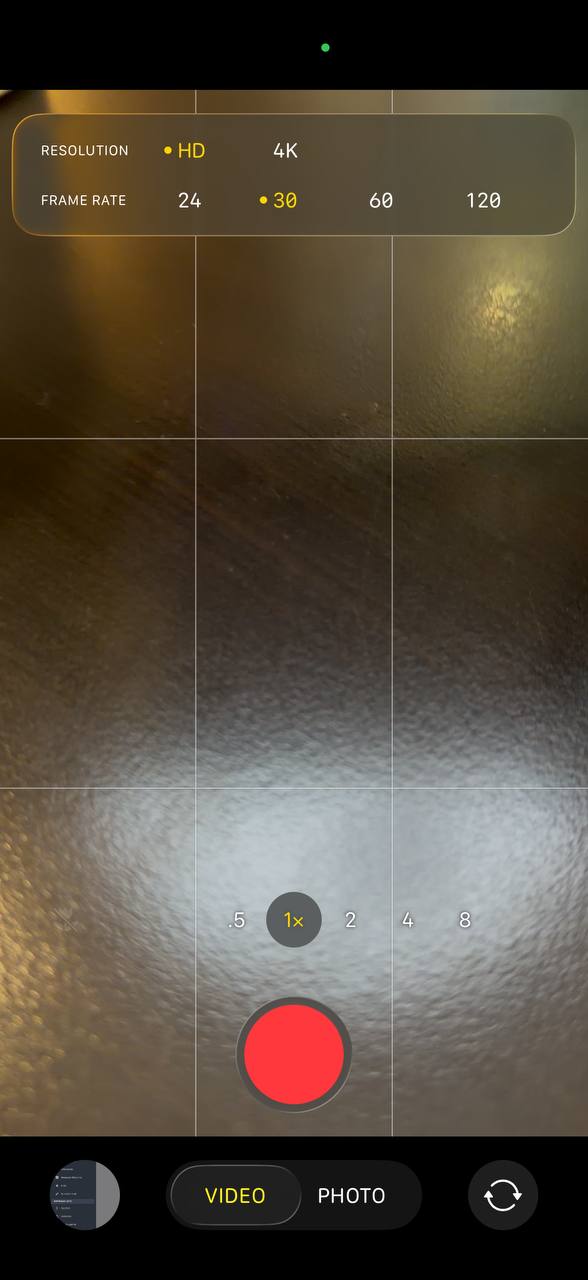
SHA-256 cd879fe7…204f5
Cinematic · HD · 30 fps
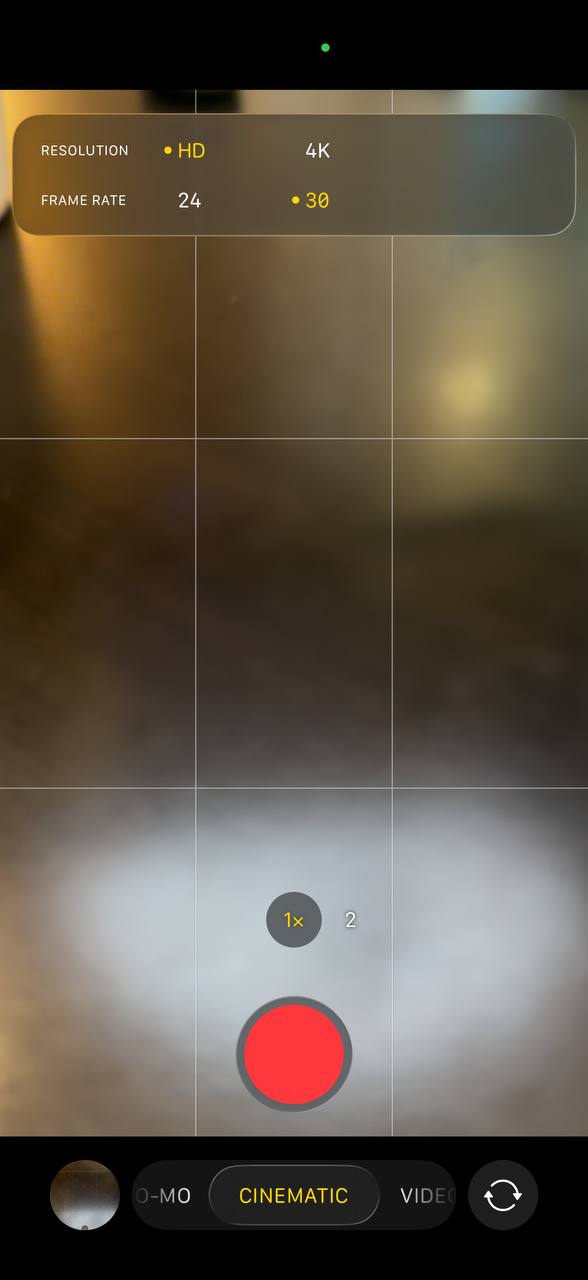
SHA-256 af6a3e2b…75630
Preserve capture and delivery separately
These screenshots prove the demonstrated Camera configurations. For each recording, retain the original iPhone asset and probe both it and the Loom-delivered copy before claiming the selected setting survived unchanged.
Stored: /filming/assets/capture-settings/
Source type 01
Loom desktop recording
Desktop Loom is commonly landscape, but the actual file and recording layout determine the treatment.
Prove the capture path
- Record a 10-second visible/audible clap test with the exact Loom, camera, and microphone setup
- Play the original Loom recording back and confirm the clap and lips align before recording the full script
- Avoid AirPods or other Bluetooth microphones unless that current setup passes the sync test
- Camera at eye level, landscape 16:9; head, shoulders, hands, and office context visible
- If Loom’s original playback is offset or drifts, use the native iPhone Camera rather than editing around an unstable source
Speak in complete blocks
- Deliver the hook, point, example, takeaway, and CTA
- Pause naturally after a mistake, then restart the full sentence
- Do not wave to signal cuts
- For multiple scripts, say “Apple” alone between scripts
- Keep the Loom recording continuous
Preserve true landscape
- Keep the authored 16:9 composition
- Do not enlarge into a face-only frame
- Use sentence-level captions in safe zones
- Cut complete redundant thoughts, not syllables
- Create vertical only with the approved 5:4-on-charcoal treatment
Landscape rule: If the source is 720p, do not call a 1080p export “new detail.” High-quality resampling can preserve perceived quality, but it cannot manufacture pixels. Proof must compare the rendered image with a composition-matched reference.
Acceptance
Desktop source passes when
Source type 02
Loom mobile — landscape or portrait
The app does not determine orientation. Probe the actual frame and preserve the recorded composition.
Build and test the chosen frame
- Choose landscape/sideways or portrait/upright intentionally; both are valid Loom-mobile sources
- Run a 10-second clap-and-speech test with the exact Loom and microphone setup
- Prefer the native iPhone Camera if Loom or Bluetooth audio shows offset or drift
- Lens clean; exposure stable; hair, chin, shoulders, and gestures inside the chosen frame
- Use a quiet route and wind protection outdoors; avoid beauty filters
Protect edit handles
- Begin with natural motion—not a still pose
- Pause after complete thoughts
- After a mistake, restart the whole sentence
- Keep pace steady enough for captions
- Use “Apple” alone only between separate scripts
Honor the measured frame
- Portrait source: preserve native 9:16 framing
- Landscape source: fit the full frame into the approved 9:16 Reel canvas
- Do not add face tracking, punch-ins, or avoidable enlargement
- Use source-specific thesis and caption safe zones
- No blur filler, cards, B-roll, or music
Walking footage rule: Stabilization, denoise, sharpening, color changes, or crop tracking are off by default. They are treatments, not repairs, and require a demonstrated problem plus a canary.
Acceptance
Mobile source passes when
Source type 03
One long recording, many “Apple”-separated shorts
This is the default batch method for scripts under three minutes.
Use one unmistakable marker
- Finish the current script completely
- Pause for roughly one second
- Say “Apple” by itself
- Pause again, reset posture, then start the next hook
- Never use “Apple” casually inside a script without flagging it
Marker creates a boundary—not content
- Detect isolated “Apple” from word timestamps
- Review every marker against audio waveform and video
- Remove the marker plus surrounding reset time
- Create one child manifest and checksum per script
- Keep original chronology and source identity
Treat each child as a complete story
- Hook, point, proof/example, takeaway, CTA
- Remove false starts and repeated versions
- Remove excess examples before cutting useful nuance
- Cut on complete phrases with visual handles
- Render and QC each child independently
Batch safeguards
How Apple splitting fails closed
Marker confidence
An isolated transcript match plus surrounding silence proposes the split. Low-confidence transcription or an in-sentence use requires manual review.
First-motion proof
Each child must show real frame variation during its first three seconds. A held poster, stale frame, or repeated frame fails—even when audio plays.
Boundary playback
Review the final five seconds before every marker and first five seconds after it. No marker audio, reset posture, prior-script tail, or clipped first word may remain.
Independent release identity
Each short receives its own title, transcript, EDL, captions, checksum, QC packet, and approval state. Duplicate titles or uploads trigger a release stop.
Current historical audit: The live YouTube API identifies an August 5 five-video batch, including two uploads titled “AI Won’t Save Your Business.” That duplicate and all five openings remain a playback-QC audit set; API titles prove inventory, not motion quality.
| August 5 live title | Runtime | Audit status |
|---|---|---|
| AI Won’t Save Your Business (Here’s What Will) | 111 sec | Two live IDs; compare master identity and opening playback |
| Your VA Is Working 3x Harder Than They Need To | 83 sec | Opening motion, crop, captions, sync |
| My 5-Minute Monday Message That Runs My Whole Week | 74 sec | Opening motion, crop, captions, sync |
| $200K/Year vs $2K/Month (Same Output or Better) | 105 sec | Opening motion, crop, captions, sync |
Editing standard
Editorial cut protocol
Remove waste at idea boundaries. Do not create robotic speech by deleting every filler word.
High-value cuts
- Silence above the chosen threshold
- False starts and full sentence restarts
- Repeated explanations of the same point
- Excess examples after the point is proven
- Off-topic setup and trailing reset time
- Apple markers and separator pauses
Natural delivery and source context
- Complete thoughts and chronological logic
- Useful nuance and distinctive examples
- Natural breath and conversational pacing
- Shoulders, gestures, and source context
- Spoken CTA and true conclusion when applicable
- Original voice attached to original video
Failure patterns
- Frozen first frame with live audio
- Detached audio or lip-sync drift
- Face-only crop from landscape
- Fast moving crop tracker
- Word-by-word filler surgery
- Social re-download used as source
Technical contract
Container lock + perceptual sync
Equal stream starts and durations prove muxing structure—not that spoken sound matches visible lips.
Non-negotiable distinction: ffprobe, matching zero timestamps, equal durations, checksums, contact sheets, and successful decode cannot prove lip sync. The rendered video must be watched in motion at clean consonant/speech onsets.
Offset rule: Check at least three clean speech onsets spanning early, middle, and late source time. A consistent offset may receive one documented global correction. A changing offset is drift and blocks release until the source is reacquired or a separately tested clock correction is approved.
Quality preservation
Required proof packet
| Check | Pass requirement | Why it exists |
|---|---|---|
| Source identity | Original checksum, Loom provenance, and rendition choice recorded | Prevents compressed or accidentally detached replacement sources |
| Loom rendition audit | Muxed source preferred; split HLS tracks compared only for diagnosis | Prevents separate-stream pairing assumptions |
| Technical probe | Expected resolution, CFR, 48 kHz, starts and durations recorded | Defines container timing without pretending it proves lip sync |
| Opening-freeze detection | Real frame variation during first three seconds | Blocks frozen-poster failures |
| PSNR / SSIM | Composition-matched comparison shows no material degradation | Quantifies image retention |
| Cut-point review | Every edit heard and watched at normal speed | Finds clipped words and visual jumps |
| Baseline lip-sync | Original Loom watched at clean early/middle/late speech onsets | Separates source offset from edit/render damage |
| Offset classification | Constant offset measured in milliseconds or variable drift explicitly blocked | Prevents guessed delays and one-point false confidence |
| Delivered motion canary | 20–30 second file is accessible and Brad confirms lips match sound | A local file path or still image is not human review |
| Full-master lip-sync | Opening, clean onsets, every cut neighborhood, middle, CTA, and ending watched | Catches offset or drift a probe cannot see |
| Caption review | Words, line breaks, safe zones, and any audio-delay shift manually checked | Captions must follow corrected audio—not stale source time |
| Full decode | Zero FFmpeg decode errors | Blocks damaged exports |
| Platform HD playback | Target high-definition rendition exists and is watched after transcode | Upload success or “processing succeeded” can still expose low-quality playback |
| Checksum handoff | Approved master hash equals uploaded master hash | Prevents wrong-file release |
Quality truth: Any edit that changes crop, scale, captions, or compression must be encoded. “No degradation” therefore means no material visible loss from the best composition-matched source reference—not a false claim of byte-identical pixels.
Release stop: Source offset not classified, inaccessible canary, missing Brad sync confirmation, drift, frozen opening, clipping, incorrect crop, avoidable enlargement, unreadable captions, unavailable platform HD, checksum mismatch, or absent Brad approval stops publication. If Brad rejects a live edit, prior approval is revoked and that version must be removed or privatized before replacement.
Copy and paste
Prompts that reactivate the exact process
Replace the bracketed values. Each prompt keeps publication locked until you approve the private master.
Classify uploaded source
Run before every editCLASSIFY THIS VIDEO SOURCE BEFORE EDITING Source: [LOOM URL OR ORIGINAL FILE] Intended destination: [REELS / SHORTS / YOUTUBE LANDSCAPE / OTHER] Return a source manifest with: • capture origin: Loom mobile app / Loom desktop / iPhone Camera uploaded to Loom / unknown • capture app and mode: iPhone Standard Video / iPhone Cinematic / Loom mobile camera / unknown • selected capture resolution: HD / 4K / unknown; keep this separate from delivered-file dimensions • selected capture rate: 24 / 30 frames per second / unknown; keep this separate from measured output fps • what evidence proves the origin; if metadata cannot prove it, ask Brad once • orientation: landscape or portrait from measured dimensions/rotation metadata • source of truth: muxed Loom rendition or original iPhone file • dimensions, frame rate, audio rate, duration, stream starts, muxed/split status, and SHA-256 • framing profile and caption safe zones for the requested destination • baseline lip-sync classification from clean early/middle/late speech onsets: aligned / constant offset / drift • proposed correction milliseconds; never inherit another video’s offset • caption offset equal to the approved audio correction • required 20–30 second accessible canary and QC gates Do not edit or publish until the manifest is complete.
Loom desktop edit
True landscape by defaultEDIT THIS VIDEO — LOOM DESKTOP Source: [LOOM URL OR ORIGINAL FILE] Inventory Loom renditions and use the best single muxed video+audio file, not separately merged HLS tracks, YouTube, or a social download. Follow the Brad–Sterling2 Video Editing Protocol: 1. Record source checksum and ffprobe evidence. 2. Preserve the authored 16:9 office/screen composition. 3. Before normalization, watch clean speech onsets early/middle/late and classify source sync as aligned, constant offset, or drift. Matching timestamps are not lip-sync proof. 4. Normalize to 30 fps CFR and 48 kHz PCM without independently resetting or stretching paired streams. 5. Build one chronological frame/sample-locked A/V EDL. If a constant correction is proven, document it and shift captions by the exact same amount. 6. Remove silences, false starts, repeated explanations, excess examples, and off-topic material at complete-thought boundaries. 7. Use the caption system: Arial Bold, two lines maximum, white base with semantic yellow/cyan emphasis, high-contrast backing, and a stable source-safe placement. No random color rotation or bouncing words. 8. Do not make a head-only crop, detached voice, blur background, B-roll, AI imagery, music, or tracking movement. 9. Deliver an accessible 20–30 second motion canary with a clean speech onset; require Brad to confirm sync before the full render. 10. Run opening-freeze, multi-point lip-sync, caption, PSNR/SSIM, decode, and checksum QC. 11. Draft platform copy with a natural topic-specific lead-in and the exact CTA: “Comment AUTOMATE and I’ll send you the Automate and Delegate newsletter.” 12. DO NOT PUBLISH until I approve the exact private master. On YouTube, keep it unlisted until the target HD rendition exists and plays.
Loom mobile edit
Measured orientation preservedEDIT THIS VIDEO — LOOM MOBILE Source: [LOOM URL OR ORIGINAL FILE] Use the original mobile Loom master. Use the single muxed Loom source when available. Preserve the measured source orientation: portrait remains native portrait; landscape uses the approved fitted-frame vertical treatment for Reels/Shorts. Preserve natural headroom, shoulders, gestures, and movement. Use fixed source-authentic framing—no face tracker or synthetic punch-ins. Before normalization, check clean early/middle/late speech onsets and classify aligned, constant offset, or drift. Create one paired A/V EDL; if a constant delay is approved, apply it once and shift captions identically. Remove complete redundant thoughts, false starts, excess examples, and silence without robotic word surgery. No blur, B-roll, AI visuals, cards, or music. Use Arial Bold captions with two lines maximum, white base plus semantic yellow/cyan emphasis, high-contrast backing, and a stable safe zone selected for the measured orientation. Deliver an accessible 20–30 second motion canary and require Brad’s sync confirmation. Then prove real opening motion, perceptual A/V alignment early/middle/CTA/ending and at every cut, coupled caption timing, image retention, full decode, and checksum identity. Draft platform copy ending exactly: “Comment AUTOMATE and I’ll send you the Automate and Delegate newsletter.” DO NOT PUBLISH until I approve that exact file.
Continuous Apple batch
Many shorts from one recordingPROCESS THIS CONTINUOUS APPLE-MARKER RECORDING Source: [LOOM URL OR ORIGINAL FILE] Base orientation: [DESKTOP LANDSCAPE / MOBILE PORTRAIT / DETECT FROM SOURCE] I recorded multiple complete videos in one continuous take and said “Apple” by itself between videos. 1. Transcribe with word timestamps. 2. Detect isolated “Apple” markers and verify each against the waveform and neighboring video. 3. Remove every marker plus reset pauses; never include it in a child video. 4. Create one child source manifest, transcript, EDL, caption file, checksum, and private master per complete script. 5. Edit each child independently for hook, point, example/proof, takeaway, and CTA. 6. Remove false starts, repeated versions, excess examples, and silence at complete-thought boundaries. 7. Preserve the base source composition and use one paired frame/sample EDL. 8. Fail any child with a frozen opening, clipped first word, prior-script tail, wrong title, duplicate identity, sync concern, or quality loss. 9. Return a batch inventory, canary/contact sheet, and private masters. 10. Draft unique platform copy for every child ending exactly: “Comment AUTOMATE and I’ll send you the Automate and Delegate newsletter.” 11. DO NOT PUBLISH any child until I approve its exact checksum.
Strict QC before release
Use after the edit is readyRUN STRICT BRAD–STERLING2 VIDEO EDITING QC Master: [PRIVATE MASTER PATH OR LINK] Source: [ORIGINAL SOURCE PATH OR LINK] Verify: • Source/master checksums and provenance • Loom rendition choice; single muxed source preferred over separately merged HLS tracks • Expected resolution, 30 fps CFR, 48 kHz, starts and durations recorded • Original-source lip sync at clean early/middle/late speech onsets • Constant offset measured in milliseconds or variable drift blocked—never infer sync from timestamps • Opening has real motion—not a held or repeated frame • Every cut at normal speed for clipped words, visual jumps, and lip sync • Opening, middle, CTA, and ending A/V alignment watched in motion • Accessible 20–30 second canary with Brad’s explicit sync confirmation • Captions for exact words, spelling, line breaks, safe zones, and identical shift when audio timing is corrected • Source-authentic framing with hair, shoulders, gestures, and context safe • Composition-matched PSNR/SSIM plus human pixel review • Full decode with zero errors • Platform-specific HD rendition available and actually playable; upload/API processing status alone does not pass • No AI visuals, unrelated B-roll, blur filler, tracking crop, detached voice, or unapproved music Return PASS/FAIL per gate, the exact approved-candidate checksum, and every blocker. DO NOT PUBLISH.
YouTube historical audit
Find failed prior editsAUDIT MY RECENT EDITED VIDEOS ON YOUTUBE Use the channel-bound YouTube API to inventory titles, IDs, dates, durations, privacy state, and duplicates. Then inspect actual playback—not only thumbnails—during the opening, each known cut area, middle, CTA, and ending. Classify every video as: • Gold reference • Technically correct but not directly approved • Failed/replaced • Needs review Specifically detect frozen first frames with live audio, lip-sync drift, face-only crops, tracking jumps, blurred filler, caption defects, duplicate uploads, wrong titles, and mismatched master identity. Do not delete, replace, or publish anything. Return the evidence matrix first.
Approved release
Only after private-master approvalAPPROVED RELEASE — EXACT MASTER ONLY Approved master: [PATH OR LINK] Approved SHA-256: [CHECKSUM] Platforms/accounts: [EXACT DESTINATIONS] Approved copy: [TITLE / CAPTION / DESCRIPTION] Release only this exact checksum. Do not regenerate, re-edit, replace captions, change compression, or substitute a derivative without stopping. Keep YouTube unlisted until its intended HD rendition exists and plays. Verify each native platform at normal-speed playback for resolution, first motion, clean-onset lip sync, captions, and ending—not only receipt/status. If Brad rejects the release, treat approval as revoked and remove or privatize it before replacement. Return native IDs, direct links, checksum proof where available, and platform-specific transcode results.